Ecommerce data privacy compliance: What you actually need to keep up with
Setup is the easy part. Here's what changes after launch, and what your team needs to watch as the business grows.

You added a cookie banner, your privacy policy is live, and maybe an attorney or compliance provider helped you get everything set up. Then the business kept moving.
Marketing added another pixel, someone installed a new Shopify app, and customer data started flowing through another vendor. A customer asked you to delete their data. Meanwhile, privacy requirements kept changing too.
Any one of those changes can affect the privacy setup you already have in place.
We see this often at TrueVault. Some ecommerce teams come to us after handling privacy compliance once and assuming they were done. Others have a cookie banner in place without realizing how much work sits behind it.
It's an understandable assumption because a lot of ecommerce data privacy compliance looks like setup from the outside: publish the policy, configure the banner, and create a way for customers to submit privacy requests.
The harder part is keeping those pieces accurate as the business changes. A policy written last year can become outdated when your data practices change. At the same time, a new app can introduce another vendor or data flow that affects other parts of your privacy program.
This guide breaks down the parts of ecommerce data privacy compliance that require ongoing attention, what tends to change, and what your team needs to watch as your business grows.
Why ecommerce data privacy compliance doesn't stay finished
Ecommerce data privacy compliance has two moving parts: privacy requirements and the business itself.
Privacy laws and data privacy regulations continue to evolve as new requirements take effect, regulators add detail, and mechanisms like universal opt-out signals change what businesses may need to account for. Privacy regulations can also introduce requirements around data protection, consent, disclosures, and consumers' privacy rights.
Your ecommerce business is changing at the same time, often much faster. New apps, vendors, pixels, tracking configurations, data uses, and updates to the website or checkout experience can all affect a privacy setup that was accurate when you first put it in place.
A useful question
Whenever something changes: what parts of our privacy setup need another look?
Answering that starts with knowing which privacy requirements apply to your business in the first place.
1. Know which privacy requirements apply to your business
Selling online means your privacy responsibilities can extend beyond the state where your company is based. If you have customers across the country, you may need to account for privacy laws in multiple states.
Which laws apply depends on several factors, including where your customers live, your revenue or the amount of personal data you process, how you use that data, and whether you handle certain types of sensitive information.
The criteria vary from state to state. For example:
California
The California Consumer Privacy Act (CCPA) applies to for-profit businesses doing business in California that meet at least one threshold, including $26.625 million in annual gross revenue or buying, selling, or sharing the personal information of 100,000 or more consumers or households.
Texas
The Texas Data Privacy and Security Act takes a different approach. It generally applies to businesses that operate in Texas or offer products or services consumed by Texas residents and process personal data. Businesses that qualify as small businesses under the federal Small Business Administration (SBA) definition are generally exempt, although requirements around selling sensitive data still apply.
For ecommerce companies that offer goods or services to people in the EU or monitor their behavior there, the General Data Protection Regulation (GDPR) may also apply, even when the company itself is established outside the EU. That can introduce additional data compliance considerations around how personal data is collected, used, stored, and transferred across borders.
The practical goal for data privacy compliance is having a reliable way to determine which requirements apply to your business and recognize when that answer changes.
For ecommerce brands, growth itself can change the answer. You might cross an applicability threshold as revenue or customer volume increases, start selling to more customers in another state, or introduce a new use for personal data. A business that correctly determined its obligations a year ago may need to revisit that assessment as it grows.
Privacy requirements can change over time. California's updated CCPA regulations, for example, took effect in January 2026 and cover areas including risk assessments, cybersecurity audits, and automated decision-making technology, with some compliance requirements phased in over time.
For an ecommerce team, that complex legal landscape comes down to a few practical questions:
What changed? Does it affect us? What do we need to do about it?
TrueVault tracks state privacy laws and evaluates changes through its compliance team. When a change affects something customers need to manage, that can translate into updates to state-law notices and request forms, new compliance tasks or vendor requirements, or a question in the TrueVault dashboard when the business needs to provide additional information.
That gives teams a way to keep up with changing requirements without independently monitoring and interpreting every development.
2. Keep track of what customer data you're collecting and where it goes
Customer data rarely stays in one place for long.
An order might start in Shopify, but information associated with that customer can also move through payment systems, email and SMS platforms, analytics and advertising tools, customer support software, loyalty programs, fulfillment providers, and other apps connected to the store.
That makes visibility into your data a foundational part of ecommerce data privacy compliance and data protection. You need a clear data inventory of what customer data you collect, why you collect it, which systems receive it, and which vendors process it on your behalf.
This is where a data map becomes useful. It creates a record of how personal data moves through your business so you can connect the systems and vendors in your stack to the privacy responsibilities they may affect.
For an ecommerce business, that might mean understanding where customer contact information goes after checkout, which marketing platforms receive behavioral data, what tracking technologies collect information from site visitors, or which vendors have access to information needed to fulfill an order.
Those answers can shape what you disclose in your privacy policy, how consent should work on your site, which vendors to consider when a customer submits a privacy request, and other compliance obligations tied to how the data is used. They can also help teams identify where appropriate security measures matter to protect personal data and reduce exposure to data breaches.
Say someone on the marketing team installs a new Shopify app three months after you mapped your customer data. That app could introduce another vendor, send customer data somewhere new, add tracking to the site, or create another use for information you're already collecting.
By then, your data map describes an older version of your store.
Does our understanding of customer data still reflect the store we're running today?
TrueVault helps establish that visibility from the start. During setup, it scans the website for detectable apps, pixels, and vendors, matches them against its vendor database, and uses that information to help build the company's data map.
That creates a clearer starting point for understanding how customer data moves through the business and where ecommerce privacy and data compliance requirements may connect to the rest of the stack.
3. Keep consent and tracking aligned with what's actually happening on your site
A cookie banner is an important part of cookie consent, and its configuration needs to match what's actually happening behind it.
Your site may have advertising pixels, analytics tags, tracking cookies, marketing tools, a tag manager, and Shopify integrations that collect or share information in different ways. As those tools change, your consent setup may need to change with them.
Consent also needs to reflect the requirements that apply to the business. Depending on the law and type of processing involved, that can include standards for valid user consent and restrictions on dark patterns that interfere with a consumer's ability to make a clear choice. Colorado, for example, requires consent in certain circumstances and does not treat consent obtained through dark patterns as valid.
Universal opt-out signals add another layer. Global Privacy Control (GPC), for example, lets someone use a browser setting or extension to communicate an opt-out preference to the websites they visit automatically. Colorado recognizes GPC as a valid universal opt-out mechanism for opting out of the sale of personal data or its use for targeted advertising. At the same time, California requires covered businesses that sell or share personal information to process qualifying opt-out preference signals.
That preference then has to translate into action behind the scenes.
210,025
GPC signals handled for one TrueVault customer in a single year, with zero manual work from the customer's team.
At that volume, automation takes a substantial operational burden off the team and handles those preferences in the background.
Other parts of consent management still require human involvement. Your team or developer may need to configure how tags are delivered and verify the setup works as intended, with TrueVault providing recommendations and implementation guidance.
Consent changes can also affect measurement. Limiting data collection may change what appears in analytics and attribution, so an unexpected shift sometimes requires looking across the broader ecommerce environment to understand what's actually causing it.
One TrueVault customer saw an analytics dip and suspected its consent banner. After investigating, TrueVault traced the issue to a Shopify change involving pixels on order-status pages.
That experience shows why ecommerce context matters when you're managing consent. Privacy, marketing, analytics, and storefront technology all operate within the same environment, so a change in one place can show up somewhere else.
4. Have a workable process for consumer privacy requests
A customer asks you to delete their personal information. The request sounds simple until you start figuring out everywhere that information lives.
Depending on which privacy laws apply, consumers may have privacy rights to access, delete, or correct their personal data, as well as opt out of certain uses such as the sale of personal data or targeted advertising. Colorado's privacy law, for example, gives consumers rights to access, delete, and correct personal data and to opt out of its sale or use for targeted advertising or certain types of profiling.
The specific requirements for handling consumer rights requests depend on the law involved. For an ecommerce team, those legal rights eventually have to become a repeatable operational workflow.
A request may require you to:
- Verify the customer when required
- Find their information across your systems
- Identify which vendors need to take action
- Account for data the business may legitimately retain
- Track the request through completion
That becomes more complicated when the customer's information lives across Shopify, your email platform, customer support software, a loyalty program, and several other systems. This is where knowing where customer data lives and which vendors have access to it becomes especially useful.
TrueVault can automate parts of that process. Opt-out requests can be sent to connected systems such as Shopify and Klaviyo with one click, while deletion requests can flow directly into integrated systems. For vendors without an integration, TrueVault provides instructions for completing the necessary steps.
Access requests can still require the business to pull together the customer's records. The goal is to automate what makes sense and give your team a clear process for everything that still needs their involvement.
5. Keep your ecommerce privacy policy and notices current
Your privacy policy describes how your business collects, uses, shares, and protects customer data, so changes to those practices can eventually require changes to what you disclose.
Say marketing introduces a new tracking technology that sends customer data to another vendor. That change may affect the data you're collecting, who receives it, and what your privacy policy needs to say about those practices.
The same thing can happen when your team finds a new use for existing data or when applicable disclosure requirements change. Over time, those changes can create a gap between what your privacy policy says and what's actually happening across the business.
A useful privacy policy reflects how your business handles customer data today. Keeping it current supports data protection, gives customers clearer information about how you handle their data, and can build customer trust.
TrueVault helps keep some of those disclosures current. State-law notices are automatically maintained as requirements change, and certain TrueVault-managed sections can reflect information from your data map and vendor list. Your team retains control over the core text of your broader privacy policy.
This reduces some of the maintenance involved in keeping disclosures current while giving your business control over what it publishes.
6. Know what the vendors in your ecommerce stack are doing with customer data
Ecommerce businesses depend on third-party tools to run nearly every part of the customer experience.
Marketing may add an app to solve a campaign problem, customer support may bring in another platform, and the loyalty team may add a new program. Each decision can introduce another company that receives or processes customer data, including third-party data shared between your business and outside platforms.
Knowing which vendors are in your stack gives you a starting point. Depending on the vendor and applicable requirements, you may also need to understand:
- What customer data it handles
- Why it processes that data
- What its privacy documentation says
- Whether particular vendor contracts or contractual requirements apply
- What data security and data protection practices are relevant to the relationship
- How it handles consumer privacy requests
Finding those answers takes work because someone has to track down the documentation, understand how the vendor processes data, and connect that information back to your own privacy program. That visibility can also matter if a vendor experiences a data breach, since breach-response and notification obligations depend on the applicable law and circumstances.
TrueVault has already done much of that research for many common vendors. Depending on the vendor, its database can include information about processing purposes and categories of personal data, relevant privacy documentation and recommendations, contact information, and details about how the vendor handles privacy requests.
That research becomes especially useful when something in your stack changes. You can see whether a new or updated vendor affects your data map, disclosures, consent setup, or the steps required to fulfill a consumer request.
What should trigger another look at your privacy program?
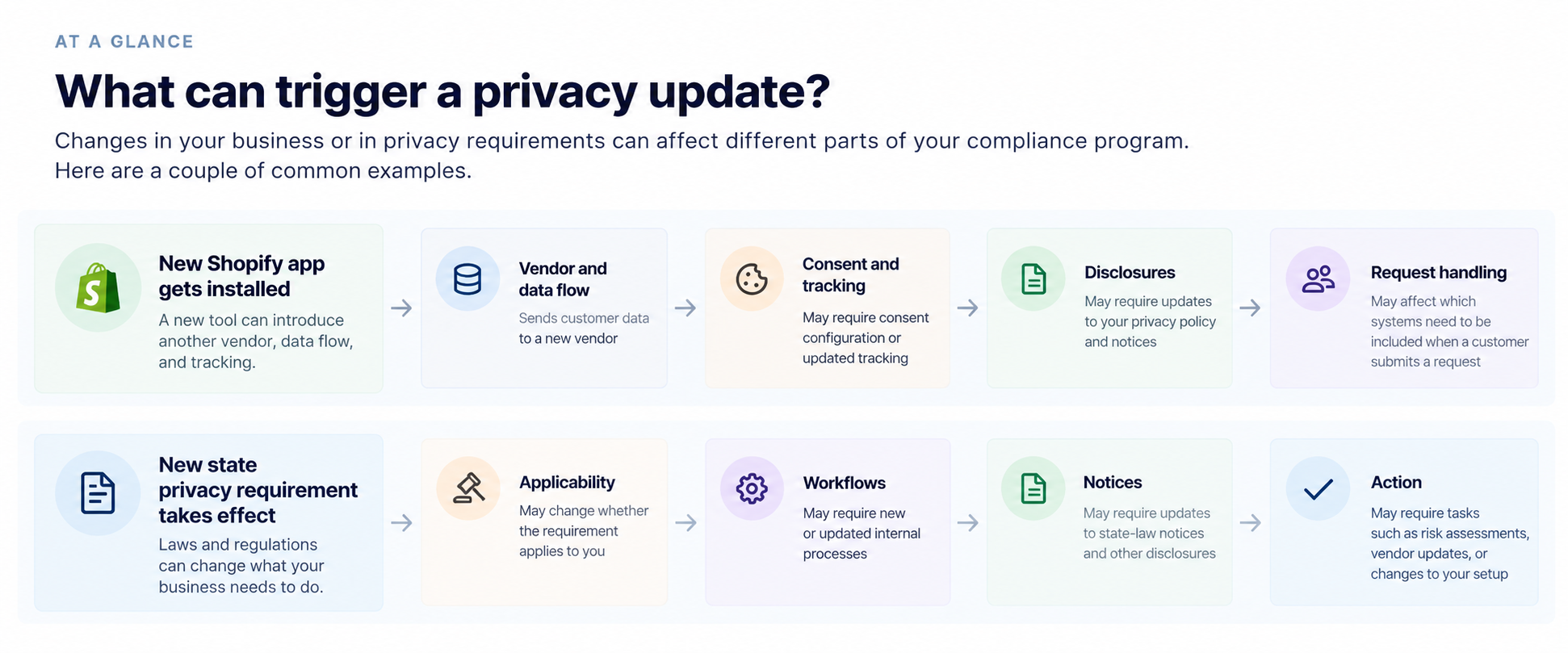
Changes inside your existing workflows can surface issues too. A consumer privacy request might reveal data in a system you hadn't accounted for, a consent setting may behave differently than expected, or someone may discover that a disclosure no longer matches what's happening on the site. Security incidents and data breaches can also require teams to revisit how they handle personal data and whether existing processes still meet applicable requirements.
When that happens, come back to one question:
What changed, what does it affect, and does anyone need to do something?
That creates a simple habit for connecting changes across the business to the parts of your privacy program they may affect.
How often should you review your ecommerce privacy setup?
No single review schedule fits every ecommerce business. How often something needs attention depends on how quickly your business changes and the privacy requirements that apply to it.
Periodic reviews can help catch changes that didn't trigger an obvious privacy task when they happened. Maybe an app was added months ago and never made it into the data map, a marketing workflow changed without anyone realizing the privacy policy needed another look, or a data breach exposed a gap in an existing process.
It also helps to make privacy review part of the changes already happening across the business. Adding a vendor, installing new tracking technology, changing how you use customer data, expanding into another market, or responding to new privacy regulations can all create a reason to revisit part of your setup. Regular reviews also give teams a chance to check whether their data compliance processes still reflect the business they're running today.
How TrueVault helps ecommerce teams keep privacy compliance current
Researching state-law changes, investigating vendors from scratch, and coordinating privacy workflows across spreadsheets and inboxes can create a lot of work for an ecommerce team.
TrueVault brings that ongoing work together. Its compliance team monitors state privacy laws and translates relevant changes into the platform, while data mapping and vendor research help connect privacy requirements to the systems handling customer data. That gives teams a practical way to manage data protection across the privacy workflows TrueVault supports without relying on a patchwork of disconnected privacy frameworks or internal processes.
Consent management and request workflows handle background work, including GPC signals and parts of consumer request fulfillment. When something requires your team's input, TrueVault surfaces questions, tasks, and practical guidance so you know what needs attention and what to do next.
The result is a privacy program that can keep moving with the business while your team spends less time researching changes and coordinating the work around them.
Privacy compliance should keep up with your business
A cookie banner, privacy policy, or one-time compliance project can put important pieces in place. As your vendors, tracking, customer data practices, and privacy requirements change, those pieces need to stay aligned with the business you're running today.
TrueVault helps make that ongoing work manageable, so your team knows what needs attention and what to do next.
Privacy work that stays current — without adding more chaos.
TrueVault helps lean ecommerce teams keep privacy workflows current as vendors, tracking tools, and privacy laws keep changing.